
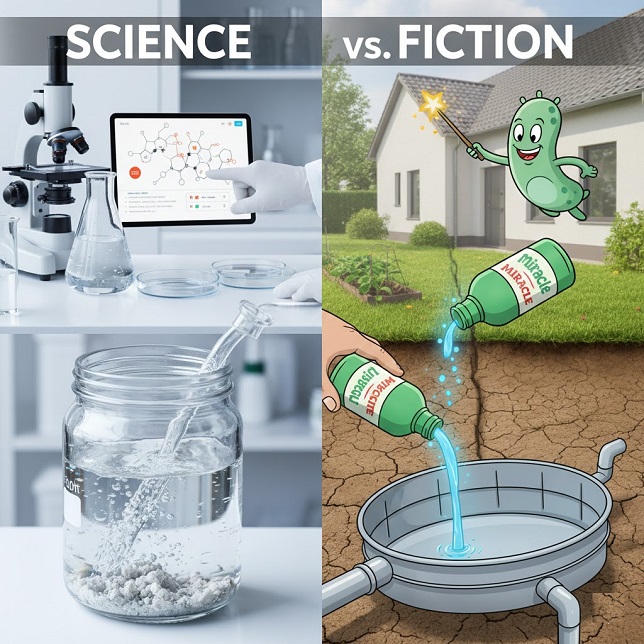
If you’ve ever stood in the plumbing aisle staring at bottles of septic tank additives, you’re not alone. The labels promise cleaner tanks, fewer pump-outs, and “no more septic problems”—all for just a few bucks. But do these products actually do anything helpful, or are you better off saving your money and calling a pro like B&B Family Plumbing when your system needs attention?
In this guide, we’ll break down what the science says, where the marketing hype comes in, and what really keeps your septic system healthy.
Your septic tank is already a living ecosystem.
Wastewater from your home flows into the tank, where naturally occurring bacteria break down solids. Heavy solids sink to form sludge, fats and oils float as scum, and the clearer liquid in the middle flows out to the drain field for final treatment in the soil.
Here’s the key point:
Septic tanks already contain all the bacteria and enzymes they need to work properly. Multiple studies and fact sheets from the U.S. Environmental Protection Agency (EPA) and university extensions have found that typical household septic systems do not need added bacteria to function.
Most septic tank additives fall into three categories:
On paper, they sound helpful. In reality, research repeatedly shows little to no performance benefit for a healthy, properly maintained septic system.
Independent studies and government-backed publications have looked at septic tank additives for decades. The consistent findings:
Because of this, the EPA clearly states that additives are not necessary for a properly working septic system and may even reduce system performance, especially at the drain field.
For an in-depth, science-based overview, you can review the EPA’s septic system care and maintenance page.
Let’s separate some popular myths from reality.
Myth #1: “Additives mean I’ll never have to pump my tank.”
Reality: No additive can remove physical solids from your tank. The only way to get rid of accumulated sludge and scum is to have the tank pumped by a professional. Additives that claim otherwise often re-suspend solids, pushing them into the drain field and causing damage.
Myth #2: “My system needs extra bacteria to work.”
Reality: Your septic system is constantly supplied with bacteria from your home’s wastewater. Studies show that additives do not significantly change bacterial populations in a meaningful or beneficial way.
Myth #3: “If my system is failing, additives can fix it.”
Reality: If your system is backing up, flooding the yard, or failing inspections, there’s an underlying problem—like a clogged line, damaged drain field, or overloaded tank. Additives can’t repair physical damage or design flaws; in fact, they may make things worse by stirring up solids or pushing waste toward the drain field.
A few experts note limited scenarios where some biological additives might be useful—like trying to “restart” a system after long disuse or where heavy chemical use (bleach, antibacterial cleaners) has weakened the natural bacteria.
Even then:
If you’re considering an additive because your system seems sluggish, talk to a licensed plumber or septic professional first. Often, the real fix is better maintenance, not more products.
Instead of spending money on septic tank additives, focus on what we know works:
At B&B Family Plumbing, we focus on these proven steps when we inspect and service septic systems—not on selling you bottles that don’t solve the real problem.
If you want a deeper dive into long-term septic care, check out our septic system maintenance guide for practical tips you can use all year.
Skip the guesswork and call a pro if you notice:
These are signs your system needs real attention, not a quick fix from a bottle.
B&B Family Plumbing can:
The bottom line? Your septic system relies on good design, solid installation, and consistent maintenance—not magic additives.
Monday – Friday 8 AM–5 PM
Saturday 8 AM–3 PM
Sunday Closed